

The booking calendar is filling up. Fresh towels are stocked. The air conditioning has been serviced. Outdoor furniture looks good. The Wi-Fi works. The cleaning team has its schedule.
Your vacation rental appears ready for the peak holiday season in Aruba!
But there is another kind of guest check that can easily be missed. A small pile of termite frass under a cabinet. A wooden doorframe that suddenly feels softer than it should. Discarded wings near a window.
A section of trim that looked perfectly normal during the previous guest’s stay.
At Rentokil, formerly Professional Pest Control Aruba, we know that termite activity does not follow a booking calendar.
And during one of the busiest periods for vacation rentals, finding the problem before a guest does can make a significant difference.
What to Look For Before Your Next Guests Arrive
Before peak holiday season begins, vacation rental owners and property managers should include termite risk in their property-maintenance check.
The goal is not to predict an infestation from one small sign.
It is to identify suspicious changes early enough for a professional to inspect them before the property enters a period of frequent check-ins, limited maintenance windows, and higher guest expectations.
A termite inspection before peak season can help answer a simple question:
Is there anything here that needs attention before the next guest arrives?
A Rental Can Look Guest-Ready and Still Have a Hidden Maintenance Problem
Termites are particularly inconvenient for vacation rentals for one reason:
Much of their activity can remain concealed.
A cleaner may notice a few pellets beneath furniture and sweep them away. A maintenance worker may see a small crack in a wooden frame and assume it is normal wear. A property manager may notice that a bathroom door is becoming harder to close and add it to the repair list.
Individually, none of those observations prove a termite problem. But they are exactly the kinds of details worth checking before the property becomes busy.
Once guests are arriving back-to-back, investigating a suspicious area becomes more difficult.
The Problem is Not Just the Wood
Imagine a guest entering a well-prepared vacation rental. Everything looks exactly like the listing photos. Then they notice a small pile of strange pellets beside the nightstand. Or several discarded insect wings around the bedroom window.
Or a piece of wooden trim that breaks when touched. Now the issue is no longer sitting quietly behind the surface. It has become part of the guest experience.
For a vacation rental, that can mean an unexpected maintenance visit during a stay, questions from the guest, room access, repairs between bookings, or a complaint that could have been avoided with earlier attention.
The termite itself is one problem. The timing of the discovery is another.
Try the property from the guest’s point of view
Before peak season, we recommend looking at the rental differently. Do not inspect it as the owner who already knows every scratch, repaired corner, and difficult door.
Walk through it as someone seeing the property for the first time.
Start Where Guests Spend the Most Time
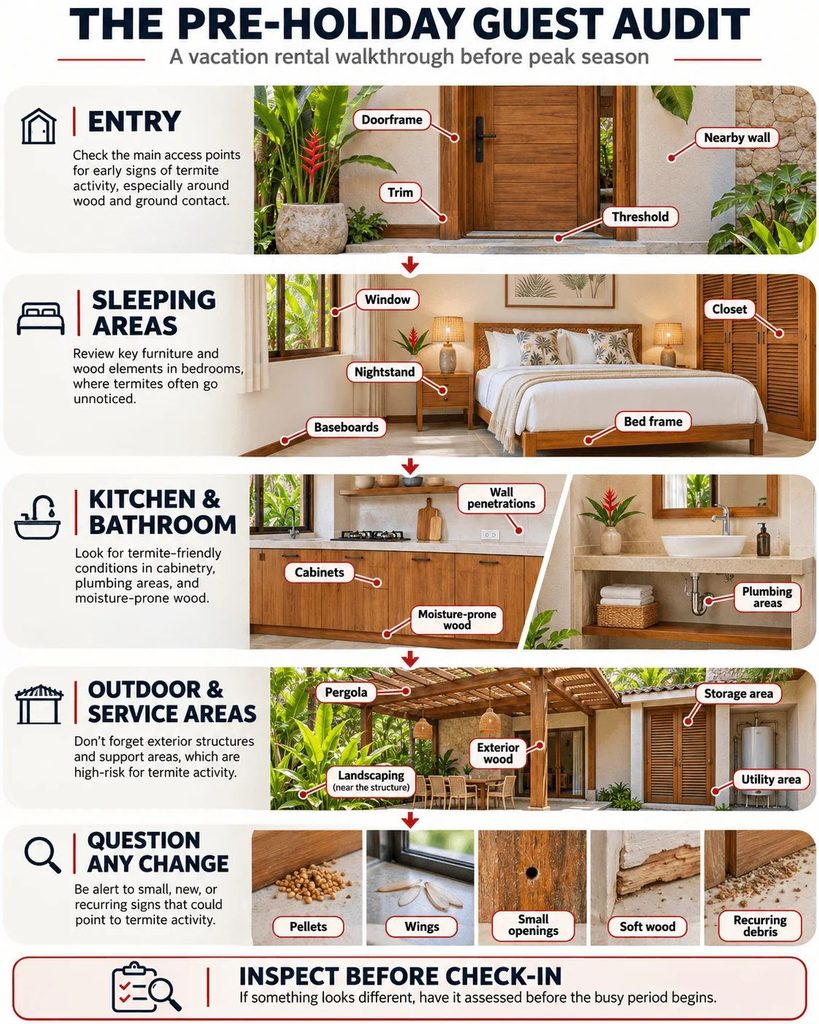
Bedrooms deserve particular attention. A guest may never inspect a utility room or look closely at the foundation.
They will notice what is beside the bed.
Check wooden nightstands, bed frames, wardrobes, baseboards, window frames, and doors for unexplained changes. Small piles of pellet-like material beneath wood can be associated with drywood termite activity.
Discarded wings around windows deserve attention too, particularly when they appear indoors. Do not automatically clean recurring debris without asking why it keeps returning.
The pattern can matter more than the size of the pile.
Then Look Where Moisture and Wood Meet
Kitchens and bathrooms often contain several things termites can exploit or travel around: cabinets, wooden trim, plumbing penetrations, wall voids, and areas affected by moisture.
A minor leak may seem like a plumbing problem. A damaged cabinet may look like normal wear. A softened piece of wood may have more than one possible explanation.
This is where guessing becomes expensive. Fixing the visible surface without determining what caused the change can leave the underlying issue unresolved.
If something looks different from the previous maintenance check, document it.
What Did the Cleaning Team Notice?
Your cleaning and maintenance teams see the property between almost every stay. That makes them valuable observers. They do not need to diagnose termites.
They simply need to know which unusual changes are worth reporting rather than automatically removing.
For example:
- Recurring pellets beneath the same wooden fixture
- Loose insect wings around a closed window
- Unexplained holes in wood
- A doorframe becoming unusually soft
- Mud-like material appearing along a wall or structural area
- The same debris returning after it has been cleaned
A quick photograph before cleanup can preserve information for the property manager or pest-control technician.
This small change in routine can turn housekeeping into an early-warning system without asking cleaners to become pest experts.
The Best Maintenance Window is the One Before the Calendar Gets Complicated
During a quieter turnover period, inspecting an unusual area is relatively simple. During peak season, the same task may have to fit between checkout and check-in.
That changes the pressure around every decision:
- Can the technician access the bedroom?
- Does furniture need to be moved?
- Can the area be repaired before tonight’s arrival?
- Does the guest need to be relocated?
- Could another booking be affected?
These questions have very little to do with termite biology. They have everything to do with operating a vacation rental. That is why a pre-season inspection can be valuable even when there is no dramatic visible damage.
A Free Inspection is Not the Same as Assuming You Need Treatment
This distinction matters. Requesting an inspection does not mean deciding in advance that a property has termites. The purpose of the inspection is to find out what is actually happening.
At Rentokil, our technicians can examine suspicious areas, look for evidence of termite activity, consider where signs are appearing, and determine whether further action is needed.
Sometimes the suspicious material has another explanation. Sometimes evidence is isolated. Sometimes the inspection reveals an area that deserves closer attention.
The value comes from knowing before the property becomes difficult to access.
Give Your Next Guest One Less Thing to Discover
Peak holiday season is when a vacation rental should be doing what it was prepared to do:
Welcoming guests.
Not opening walls.
Not investigating mysterious debris between bookings.
Not trying to determine why insect wings suddenly appeared beside a window.
Before the busiest check-ins begin, add one more question to the maintenance list:
Has anything changed that could point to termite activity?
If the answer is “maybe,” you do not need to diagnose it yourself.
Contact Rentokil, formerly Professional Pest Control Aruba at +297 582 5002, and request a free termite inspection before peak season.
The property can be checked while there is still time to make informed maintenance decisions, rather than reacting after a guest has already noticed something.
A free inspection can help you find the problem before your next guest does. Our experts in Aruba are ready to guide you with the best treatment option and prevention tips!